

Medical Weight Loss UK: A Complete Guide to Clinician-Led Programmes
Editorial TeamThis guide explains how medical weight loss works in the UK, who is eligible,
what treatments are available including Wegovy and Mounjaro, and how to choose
a safe regulated provider. It covers both NHS and private pathways.
Last reviewed: April 2026 by the Foundry Editorial Team.
Contents
1. What Is Medical Weight Loss?
2. How It Differs from Traditional Dieting
3. Who Is Eligible?
4. NHS vs Private: How They Compare
5. Treatments Available in the UK
6. Your Patient Journey
7. How to Choose a Safe Provider
8. Lifestyle and Long-Term Results
9. Frequently Asked Questions
10. Clinical Sources
Understand how medical weight loss works in the UK, from eligibility and treatments to choosing a safe, regulated programme for your health journey.
For many people, managing weight is a complex and often frustrating challenge. If you've tried traditional methods like diet and exercise without achieving the long-term results you need, you are not alone. Medical weight loss offers a different path—one that is supervised by clinicians and uses evidence-based treatments to support your health.
This guide explains what medical weight loss involves in the UK, how the treatments work, and most importantly, how to choose a safe and regulated provider for your journey.
What Exactly Is Medical Weight Loss?
Medical weight loss is a comprehensive approach to weight management that is supervised by qualified healthcare professionals. Unlike commercial diet plans or over-the-counter supplements, it uses clinical assessments and evidence-based treatments, including prescription medications, to address the biological factors that can make losing weight difficult.
The primary goal is not just weight reduction, but the improvement of your overall long-term health, helping to manage or reduce the risk of weight-related conditions.
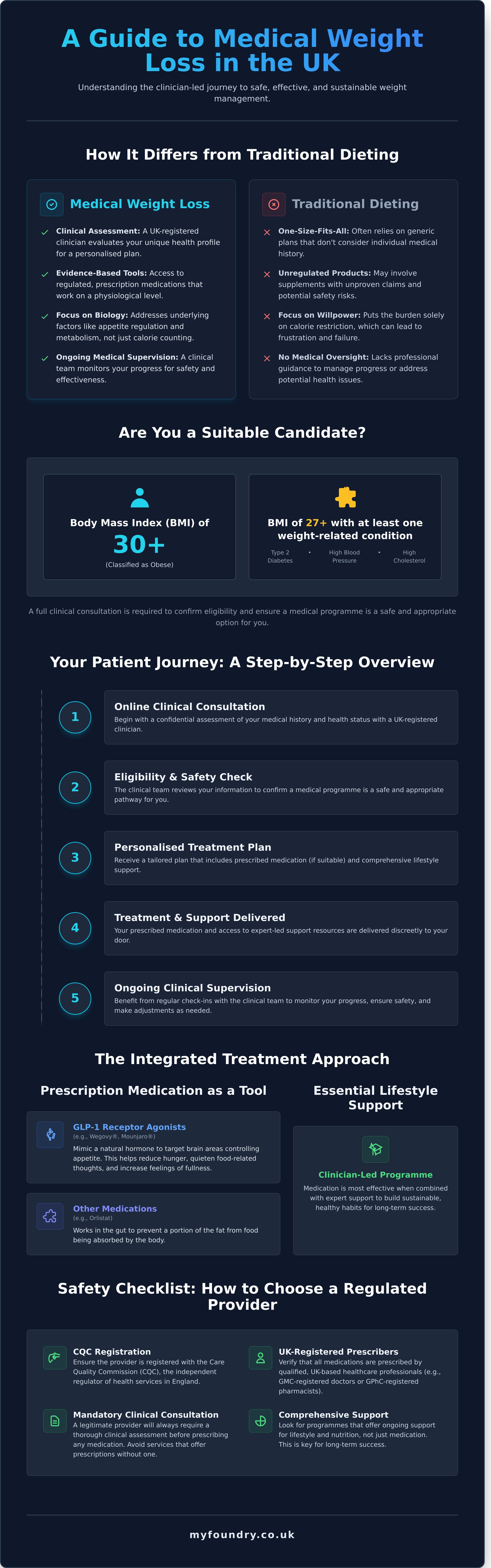
How It Differs from Traditional Dieting
While both involve lifestyle changes, medical weight loss is fundamentally different from dieting alone.
- Clinical Foundation: It begins with a thorough clinical assessment by a healthcare professional to understand your unique medical history and needs.
- Addresses Biology: It acknowledges that weight is influenced by complex biological factors like hormones and metabolism, not just willpower.
- Uses Prescription Tools: It incorporates licensed, prescription-only medications that are not available to the public and are proven to be effective in clinical trials.
- Ongoing Medical Supervision: Your progress, dosage, and any side effects are continuously monitored by a clinician to ensure your treatment is both safe and effective.
Who is a Suitable Candidate for Medical Weight Loss in the UK?
Medical weight loss programmes are not for everyone. They are designed for individuals who have a clinical need for weight loss. In the UK, eligibility criteria, guided by organisations like NICE (National Institute for Health and Care Excellence), generally include:
- A Body Mass Index (BMI) of 30 or higher (defined as obesity).
- A BMI of 27 or higher with at least one weight-related health condition, such as high blood pressure, type 2 diabetes, or high cholesterol.
These programmes are typically recommended for those who have already tried to lose weight through diet and exercise but have not been successful. A full clinical consultation is always required to determine if you are a suitable candidate.
Types of Medical Weight Loss Treatments Available in the UK
A clinician will recommend the most appropriate treatment based on your individual health profile. The cornerstone of modern medical weight loss is often a combination of prescription medication and the lifestyle changes that medication helps to enable. Treatment is available through the NHS, though criteria can be strict, or through regulated private providers like Foundry Health.
Prescription Medications: How They Work
Modern weight loss medications are a significant medical advancement. They are prescribed by a qualified clinician and work by targeting the underlying biology of appetite and metabolism.
- GLP-1 Receptor Agonists: This is the leading class of medication. Drugs like semaglutide (Wegovy®) and tirzepatide (Mounjaro®) mimic a natural gut hormone that signals to your brain that you are full. This helps to reduce your appetite, quieten cravings or 'food noise', and ultimately lower your calorie intake without a constant feeling of hunger.
- Other Options: Medications like Orlistat work differently by preventing some of the fat you eat from being absorbed by your body.
It is critical to remember that these are powerful, prescription-only medicines that require proper clinical oversight to be used safely.
The Importance of Lifestyle Changes Alongside Medication
Medication is a powerful tool, but it is most effective when used to support sustainable lifestyle changes. Clinician-led programmes are built on this principle. While the medication works to manage the biological drivers of weight gain, it creates a crucial opportunity for you to build healthier, long-lasting habits. The role of the clinician is to provide the medical treatment and guidance that makes adopting these new habits more achievable.
NHS vs Private Medical Weight Loss: How They Compare
| NHS | Private (e.g. Foundry) | |
| Eligibility threshold | Strict - Tier 3 referral required | BMI 30+, or 27+ with health condition |
| Waiting time | Up to 5 years in some regions | Days to weeks |
| Cost | Free at point of use | From £60/month with Foundry membership |
| Medications available | Wegovy, Orlistat | Wegovy, Mounjaro, Orlistat |
| Ongoing clinical support | Yes, via GP and specialist | Yes, via UK-registered prescribers |
| Convenience | In-person appointments | Fully digital, managed from home |
For most patients who do not qualify for NHS fast-track access, regulated private
care offers the fastest and safest route to treatment.
Accessing Treatment Through the NHS vs. Private Clinics
- NHS Pathway: Access to weight loss medication on the NHS is possible but often involves long waiting lists and very strict eligibility criteria, typically requiring referral to a specialist tier 3 weight management service.
- Private Clinics: Regulated private clinics offer a more accessible alternative, providing faster access to consultations and treatment. They offer convenience through digital platforms, allowing you to manage your journey from home. However, it is vital to choose a provider that is properly regulated to ensure your safety.
See if you're eligible for our clinician-led programme.
Your Patient Journey: What to Expect from a UK Programme
Starting a medical weight loss programme online can feel daunting, but a regulated provider will have a clear, safe, and professional process. Here is what you should expect.
Step 1: The Initial Online Consultation
Your journey begins with a comprehensive and secure online consultation. This is not just a simple form; it's a detailed medical questionnaire covering your health history, current conditions, and any medications you take. Providing accurate information is essential for your safety. This assessment is then carefully reviewed by a UK-registered clinician or prescriber to determine your suitability for treatment.
Step 2: Creating Your Personalised Treatment Plan
If the clinician approves you for treatment, they will create a personalised plan. This includes selecting the right medication and dosage schedule for your needs. The prescription is then sent directly to a regulated UK pharmacy. The pharmacy will dispense your medication and deliver it in discreet packaging to your home.
Step 3: Ongoing Support and Clinical Monitoring
Treatment does not end when your medication arrives. Safe and effective programmes involve continuous clinical care. This includes:
- Regular Check-ins: You will have regular follow-ups with the clinical team to monitor your progress, track health metrics, and discuss how you are feeling.
- Side Effect Management: Your clinician will help you manage any potential side effects, which are often mild and temporary.
- Dosage Adjustments: Your clinician will adjust your medication dosage over time according to the prescribed schedule to maximise effectiveness and minimise side effects.
This ongoing clinical relationship is key to achieving safe, long-term results.
"The patients who achieve the best long-term results are those who treat
medication as one part of a broader clinical strategy. Regular check-ins,
honest conversations about side effects, and dose adjustments based on
individual response - that is what separates a medical programme from a
simple prescription." - Foundry Clinical Team, UK-Registered Prescribers
How to Choose a Safe and Regulated Provider in the UK
The online healthcare space is growing, and unfortunately, not all providers operate to the same high standards. Empowering yourself with knowledge is the best way to make a safe choice.
Check for Key Regulatory Bodies
A legitimate UK healthcare provider will be transparent about its regulatory status. Look for evidence of registration with:
- CQC (Care Quality Commission): Regulates all providers of healthcare services in England to ensure they meet fundamental standards of quality and safety.
- GPhC (General Pharmaceutical Council): Regulates all pharmacies in Great Britain. Ensure the provider’s partner pharmacy is GPhC-registered.
- MHRA (Medicines and Healthcare products Regulatory Agency): Governs the safety and licensing of all medicines in the UK.
You should be able to find this information clearly displayed on the provider’s website.
Red Flags of Unsafe Online Sellers
Be cautious of any website that exhibits these warning signs:
- Sells prescription medication without requiring a consultation or prescription.
- Uses a simple tick-box form with no review by a registered clinician.
- Is not transparent about who its clinicians are or where its pharmacy is based.
- Makes unrealistic claims like "guaranteed results" or "instant weight loss."
Questions to Ask a Potential Provider
Before committing, ask these critical questions:
- Are your prescribers registered with a UK professional body like the GMC (General Medical Council) or GPhC?
- What does your ongoing clinical support involve after the first prescription?
- How do you monitor patients and manage potential side effects?
- Is your dispensing pharmacy located in the UK and registered with the GPhC?
The Essential Role of Lifestyle in a Medical Programme
It’s important to view weight loss medication as a tool that enables change, not a passive solution. The most successful and sustainable results come from using this medical support to build a healthier lifestyle for the long term. A responsible medical programme is designed to facilitate this.
Using Medication to Build a Foundation with Nutrition
GLP-1 medications significantly reduce appetite and the persistent "food noise" that can make healthy eating difficult. This creates a powerful opportunity to reset your relationship with food. With hunger and cravings managed, it becomes easier to focus on nutrient-dense foods, learn appropriate portion sizes, and build eating habits that are sustainable far beyond a restrictive diet.
Integrating Activity for Long-Term Health
As you begin to lose weight, physical activity often becomes easier and more enjoyable. The goal isn't to engage in gruelling exercise, but to find consistent and enjoyable forms of movement. Regular activity offers benefits far beyond burning calories, including improving metabolic health, preserving muscle mass during weight loss, and boosting mental well-being. The medication gives you the support to start building this positive momentum.
Frequently Asked Questions
Can you get medical weight loss treatment on the NHS?
Yes, but access is limited. NHS weight loss medication is available through
specialist Tier 3 weight management services. Waiting times in some regions
have exceeded five years. Private access is faster but comes at a cost.
How much does a private medical weight loss programme cost in the UK?
Costs vary by provider and medication. In 2026, Wegovy starts from around
£130/month and Mounjaro from £149/month at starting doses. Foundry members
can access treatment from £60/month with an annual membership of £249.
Are Wegovy and Mounjaro safe for long-term use?
When prescribed by a UK-registered clinician after a thorough assessment and
used under continuous clinical monitoring, both medications have a well-established
safety profile. The MHRA continuously monitors both through the Yellow Card scheme.
How much weight can I realistically expect to lose?
Clinical trial data shows semaglutide (Wegovy) supports average weight loss of
15-20.7% of body weight over 68 weeks. Tirzepatide (Mounjaro) supports average
loss of 22.5% at maximum dose over 72 weeks. Individual results vary based on
dose, adherence, and lifestyle factors.
What are the most common side effects?
The most common side effects of GLP-1 medications are gastrointestinal - nausea,
constipation, or diarrhoea. These are usually mild to moderate and decrease over
time as your body adjusts. Your clinician will help you manage them.
Do I have to stay on medication forever?
Obesity is a chronic condition and these medications are designed for long-term
use. Stopping treatment often leads to weight regain. The goal is to use the
medication alongside sustainable lifestyle changes to maintain a healthier weight.
What is the difference between Wegovy and Mounjaro?
Wegovy contains semaglutide, a GLP-1 receptor agonist. Mounjaro contains
tirzepatide, which targets both GLP-1 and GIP receptors. Clinical trials suggest
Mounjaro produces slightly higher average weight loss. However, Mounjaro is
currently more expensive following a price increase in September 2025.
Is a clinical consultation always required?
Yes. Since 2025, GPhC regulations require a clinical consultation before any
prescription can be issued. An online questionnaire alone is no longer sufficient.
Any provider that does not require a clinical review should be avoided.
Ready to take the next step on your health journey?
Start your confidential online consultation today
- Expert care from UK-registered clinicians
- Regulated by the CQC for your safety
- Medication dispensed by a GPhC-registered UK pharmacy
Clinical Sources
1. NICE Guidelines - Obesity: identification, assessment and management.
https://www.nice.org.uk/guidance/cg189
2. NHS - Weight loss surgery and medication overview.
https://www.nhs.uk/conditions/obesity/treatment/
3. STEP 1 Trial (2021) - Wilding JPH et al. Once-Weekly Semaglutide in
Adults with Overweight or Obesity. New England Journal of Medicine.
https://www.nejm.org/doi/full/10.1056/NEJMoa2032183
4. SURMOUNT-1 Trial (2022) - Jastreboff AM et al. Tirzepatide Once Weekly
for the Treatment of Obesity. New England Journal of Medicine.
https://www.nejm.org/doi/full/10.1056/NEJMoa2206038
5. SELECT Trial (2023) - Lincoff AM et al. Semaglutide and Cardiovascular
Outcomes in Obesity without Diabetes. New England Journal of Medicine.
https://www.nejm.org/doi/full/10.1056/NEJMoa2307563
6. MHRA Yellow Card Scheme - Ongoing pharmacovigilance for GLP-1 receptor
agonists in the UK. https://yellowcard.mhra.gov.uk
7. GPhC Guidance (2025) - Requirements for prescribing weight loss medication
online. https://www.pharmacyregulation.org